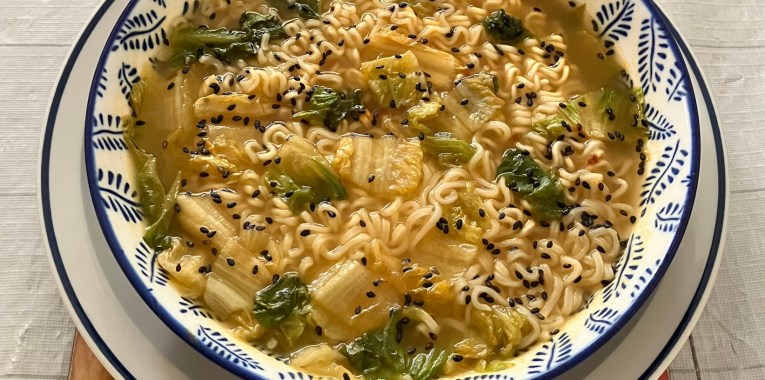

I bought miso paste and black sesame seeds to try. Choy sum and cabbage are on sale. I couldn’t find udon noodles, so I used shin ram yun noodles with the miso paste and black sesame seeds. If you don’t try this flavour combination, you’ll miss out on a great taste.
Google: “Miso paste is a traditional Japanese seasoning made by fermenting soybeans, salt, and koji (a fungus), with some types including rice or barley. This fermentation creates a rich, savoury flavour used in soups, stews, and marinades. Miso can taste different based on its type and fermentation time. It’s a good source of protein, minerals, and healthy bacteria, which may help gut health and offer antioxidants.”
Google: “Choy sum, also known as Chinese flowering cabbage or cai xin, is a leafy green vegetable belonging to the Brassica rapa species. It’s a popular ingredient in Asian cuisine, particularly Chinese, and is characterized by its tender stems, dark green leaves, and occasional yellow flowers. The vegetable has a mild, slightly sweet flavour and a crisp texture. Choy sum is a good source of vitamins and minerals.”
Google: “Napa cabbage is a type of Chinese cabbage from the Beijing region of China, commonly used in East Asian dishes. Since the 20th century, it has also been grown in Europe, the Americas, and Australia, where it is often called “Chinese cabbage.” This vegetable is rich in vitamins C and K, which support the immune system and help with blood clotting. It also provides vitamins A, B6, and B12, along with calcium, potassium, and iron, important for bone health and energy. Its high fiber content aids digestion and supports weight management. Additionally, the antioxidants in Chinese cabbage help protect cells, while the potassium, magnesium, and calcium contribute to blood pressure regulation.”
“Black sesame seeds are the dark seeds of the Sesamum indicum plant, which also produces white sesame seeds. They have a richer flavour and crunch compared to white sesame seeds. Common in many Asian dishes, black sesame seeds are also used in traditional medicine. They are rich in calcium, iron, magnesium, zinc, and antioxidants, promoting bone health, skin elasticity, hair growth, and helping to regulate blood pressure. Sesamin and sesamol found in black sesame seeds may offer cancer protection.”
Here’s my lazy simple lunch with my favourite noodles soup. I had added all the healthy food into it, and it’s comforting and delicious. Let’s cook!!!
Ingredients
1 packet shin ram yun
2 napa cabbage leaves
2 stalks choy sum
1 Tsp miso paste
hot boiling water
Method
Put kettle on. wash and cut choy sum and cabbage; remove coarse outer leaves into bite size. Empty the sin ram yun noodles packet and the condiments that comes with it on to a bowl. Once water is boiled, pour it into a metal bowl with choy sum stems.
Blanch for about 1-2 minutes, or until the stems are tender. Then the leaves for 1minute. Immediately drain the choy sum and rinse with cold water to stop the cooking process. Or you can use slotted spoon to spoon it out onto a paper towel place on top of tea towel. Pat dry; gently squeeze the blanched choy sum to remove excess water.
Using the same metal bowl with hot boiling water, add cabbage. Blanch for about 1-1.5 minutes. Drain the Napa cabbage and rinse with cold water. Blanching helps to tenderize the vegetables, making them easier to digest. Blanching can help preserve the bright green colour and natural flavours of the vegetables. Blanched vegetables are often used in stir fries, soups, or other dishes where they’re finished with other cooking methods.
Don’t discard the hot blanching water. Pour enough of the blanching water into the prepared bowl with shin ram yun noodles and condiments. Put into microwave, cook for 6 minutes. Bring out and add the blanched vegetables into the noodles soup bowl. Put back into microwave and cook a further 1-2 minutes until noodles are softened and both vegetables are warmed up. Bring out the bowl from microwave.
“Miso is a fermented product, and its flavour and nutritional benefits are best preserved when it’s added at the end of cooking, not boiled. Miso is a stubborn thing that doesn’t soften quickly with heat. It is advised that you strain the miso into the broth. You can buy a Japanese strainer or place the miso paste in a separate bowl and add a ladleful of stock from the pot, then whisk until smooth before pouring back into the main pot.”
Use a ladle spoon out the shin ram yun soup onto a bowl, and add 1 Tsp of miso. Then use a small whisk to whisk the miso paste until no lump until it’s smooth. Now pour it back into the noodles soup bowl. Sprinkles some black sesame seeds onto the noodles soup. Serve immediately with green tea. Enjoy!!!
Note: “AVOID BOILING MISO: The aromatic qualities of miso – as well as some of the nutritional benefits – are damaged when boiled. STRAIN MISO FOR SOUPS AND BROTHS: This is an incredibly important step when miso is added at the end of cooking. THIN MISO BEFORE MAKING DRESSINGS & SAUCES: miso would remain lumpy, clinging onto your salad leaves in a rather unappetising way. I recommend that you thin the miso first with another liquid – perhaps olive oil or sake – in a bowl with a spoon or a small whisk.”
“Miso makes a wonderful marinade but being composed primarily from soybeans doesn’t melt. Many miso marinades also contain sugar, so have a tendency to burn. This can create a great tarring flavour such as in grilled cod miso… but there is a fine line between smoky umami flavours and a bitter coating that ruins a dish, so keep an eye on the heat. My trick is to blot marinated items with a kitchen paper before putting them in the oven, grill or pan, leaving the thinnest layer behind; not cooking them dripping them with sauce as a barbecue marinade. With miso marinades, less is more, trust that the flavour has already penetrated the meat, fish or vegetables.
“Miso should be stored in a covered container and to maintain its colour and flavour, refrigeration is best. As a general rule, the lighter the colour and flavour, the more careful you will need to be and refrigeration is best.”
“Sweet miso should be consumed within three weeks of opening, white miso within 3 months. Darker misos, such as barley, brown rice and red miso keep for at least 6 months, and soybean miso for 12 months. Beyond these periods the miso won’t spoil, but the flavour and colour will change becoming less aromatic. Soybean miso, which contains much less salt becomes harder too. If you see your miso forming white or green mould on top, simply skim off as you would with jam. Pinkish mould are a more serious matter and you will need to scrape very deeply and use the remaining untainted miso within the next day or too, or throw out.”
https://helenscchin.com/2015/04/21/shin-ram-yun-miso-vegetables-and-black-sesame-seeds-noodles-soup/
#helenscchinrecipes
#asianculinarycurrynoodles
#cookingforthefun
#foodiesplus
 helenscchin's Blog
You must be logged in to post a comment.